Theorem 1: The 2-for-1
Claim
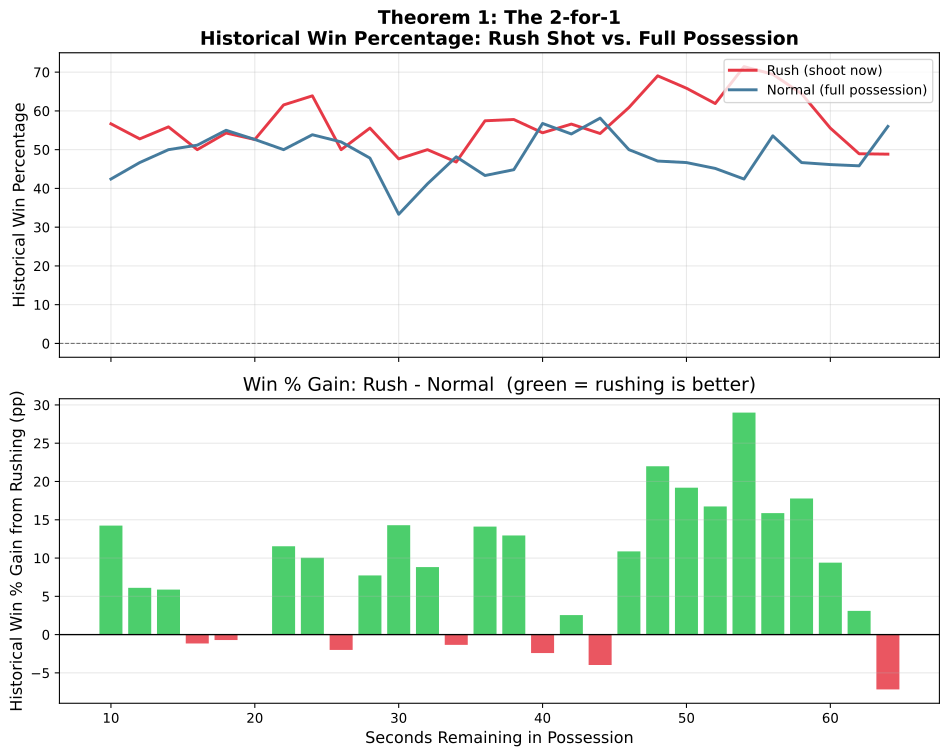
Does taking a quick shot in a tied game improve the chance of winning when 30--40 seconds remain?
How We Measure It
At each clock value from 30 to 40 seconds, we filter for tied games and include both home and away possessions whose next logged event is a shot by the team with the ball. We group those possessions by timing:
- Rush: The shot occurs within five seconds of the target clock.
- Normal: The shot occurs more than five seconds later.
The saved sweep reports the possessing team's historical win percentage, observation counts, and pointwise 95% uncertainty intervals. Each interval uses the wider limits from a game-cluster bootstrap and Wilson/Newcombe finite-sample bounds. Games are resampled as blocks so repeated clock values and overtime periods from the same game remain together. This is a descriptive association, not a causal estimate; team quality and game context are not adjusted for.
Results
Conclusion
Rushing had the higher observed win rate at 4 of 6 comparable clock points. The 95% interval excluded zero in favor of rushing at 0 points. The result is mixed and should not be interpreted as a causal effect.